• NCAM010.jpg
  • NCAM011.jpg
  • NCAM020.jpg
  • NCAM030.jpg
  • NCAM031.jpg
  • NCAM040.jpg
  • NCAM041.jpg
  • NCAM050.jpg
  • NCAM051.jpg
  • NCAM060.jpg
  • NCAM061.jpg
  • NCAM070.jpg
  • NCAM071.jpg
  • NCAM080.jpg
  • NCAM081.jpg
  • NCAM21.jpg
  • NCAM100.jpg
  • NCAM101.jpg
  • NCAM110.jpg
  • NCAM111.jpg
  • NCAM120.jpg
  • NCAM121.jpg
  • NCAM130.jpg
  • NCAM131.jpg
  • NCAM140.jpg
  • NCAM141.jpg
  • NCAM150.jpg
  • NCAM151.jpg
  • NCAM160.jpg
  • NCAM161.jpg
Home

Latest News

Popular

Home


The Executive Director is the Chief Accounting Officer and the Chief Administrative Officer of the Centre and is responsible for the day–to–day running of the Centre with the assistance of his Management Staff.

The Director's Office consists of the following Sections/Units:

-           Works

-           Library

-           Internal Audit

-           Editorial Unit

-           NCAM Clinic

-           Linkage Programmes

-           Publications Unit

-           Testing, Standardization and Certification.


NCAM Departments

The Human Resources Development Department (HRDD):

The HRDD is a service-oriented department which is primarily focused on the coordination and provision of support services for general administration of the Centre.  The department covers personnel activities and human capital/ resources development for both technical and administrative staff.  The department presently maintains a staff strength of 23, which cuts across different cadres and designations.

The HRDD is subdivided into two (2) Units, viz:

i.          Education and Training

ii.          Personnel Management.

Education and Training:

The Education and Training Unit coordinates all training activities, including Facilitation of Seminars, Workshops, Students' Industrial Training (IT), Excursions and Exhibitions.  Management and staff members are regularly sponsored on different training workshops, seminars and conferences with the aim of improving and increasing their knowledge and productivity in their different areas of specialization.

Personnel Management:

The Personnel Management Unit is charged with the responsibility of assisting the Executive Director of the Centre in personnel duties, to ensure a conducive administrative atmosphere, for effective and efficient realization of the mandate of the Centre.

The Unit which is currently headed by an Assistant Director performs among other functions:

-           Appointments:

-           Ratification and Confirmation of Appointments:

-           Promotions:

-           Disciplinary Matters:

-           Pension Matters in accordance with existing rules and regulations:

-           Staff Welfare:

- Security:

-           Allocation of staff quarters/accommodation of guests:

-           Record keeping on staff matters:

FINANCE AND ACCOUNT

The Department is comprised of the following Units/Sections:

(i) Main Account

(ii) Salaries & Wages

(iii) Final Accounts & Budget & Planning

(iv) Central Pay Office

(v) Stores

(vi) Procurement.

TECHNICAL DEPARTMENTS/PROGRAMMES/UNITS

NCAM’s expected activities encapsulate a totality of operations involved in crop production: land clearing and land development, erosion control, weeding, harvesting, crop processing, irrigation, the use of small-scale tools and equipment, and animal draft power systems.  Land preparation, planting, produce handling, storage, haulage and packaging are considered significant activities of NCAM in order to flesh out a balanced approach in agricultural practices, though these are executed in collaboration with other relevant research institutes/establishments working on similar production operations to avoid efforts duplication.  These activities are executed within the ambit of specific programmes and services which have been re-modified into functional traditional disciplines of the Agricultural Engineering Profession for efficiency and effectiveness in practice.  The programmes include:

(1)       Farm Power and Machinery Department: This comprises the following Units:

(a) Farm Power;

(b) Farm Machinery Systems Development and Management;

(c) Ergonomics; and

(d) Renewable Energy Resources.

(2) Processing and Storage Engineering Department:

(Until recently known as Processing and Environmental Control Department).  This consists of the following units:

(a) Cereal Grain Crop Processing;

(b) Oil Crops and Grain legumes Processing;

(c) Root and Tuber Crop Processing;

(d) Fruits and vegetable Processing;

(e) Fibre crops Processing;

(f) Livestock products Processing;

(g) Farm Structures;

(h) Rural Electrification; and

(i) Environmental Control and Waste Management

(3) Land and Water Management Department: This subsumes the following units:

(a) Land clearing and development;

(b) Irrigation and Drainage;

(c) Soil Erosion Control and Soil Water Management;

(d) Agro-meteorology; and

(e) Soil Tillage

(4) Engineering and Scientific Services Department:

This constitutes the nucleus of the programmes of the Centre and includes the following units;

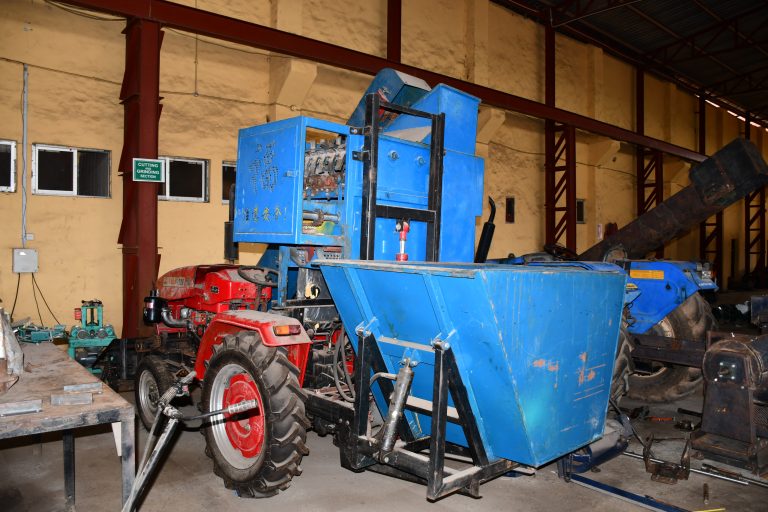
(a) prototype fabrication;

(b) Instrumentation;

(c) Maintenance of Scientific equipment;

(d) Workshop Technology; and

(e) Design and Drafting.

(5) Agro-Industrial Development and Extension Department:

This comprises the following units:

(a) Product development; and

(b) Extension

(6) There are also other units of the Centre subsumed under the Directorate: These include:

(a) Testing, Standardization and Certification

(b) Publication

(c) Linkage Programmes; and

(d) Computer Laboratory Services

(e) Seminar, Workshop & Library Services

NCAM was deliberately and strategically located between the forest and savannah ecologies to make for effective and efficient coverage of agricultural operations in both ecologies.  Howbeit, for the purposes of more effective testing of equipment/technologies and more efficient propagation of research and development activities to end users, three sub-centres were proposed for the three distinct ecological zones of the country as earlier stated.

Staff Strength

The staff strength of NCAM is about 18… This comprises research engineers, research scientists, technologists, administrators and finance personnel.